Showing posts with label opensim. Show all posts

Sunday, January 1, 2012

AO horse in Opensim

I failed to create a horse as a vehicle in Opensim. So instead of riding a horse the avatar will wear one. Using the animated sculptie horse I made earlier I've added this animation overrider script from Catherine Pfeffer and Carn Iggle posted at the OSgrid forum.


Downloads


http://www.mediafire.com/file/xupwyneu88xbl2x/animkabayoAO.iar (190 KB)
http://www.mediafire.com/file/et4lk9hbdysuabc/riderao.lsl (2 KB)

http://www.mediafire.com/file/7e13tcafsds94kz/riderpose.bvh (19 KB)

http://www.mediafire.com/file/byvmwggb5uj12mw/ridertrot.bvh (19 KB)

QAvimator source file

http://www.mediafire.com/file/im6ribf75gybqtr/riderpose.avm (19 KB)
http://www.mediafire.com/file/csx0ois20vy0sl0/ridertrot.avm (19 KB)

The AO script may be improved by having separate animations play for standing and walking. Unfortunately I do not know how to modify it. In addition the animation needs to be modified to meet the height of the rezzed horse otherwise the horse would need to be scaled and may be too small for the avatar.


Friday, December 23, 2011

Secondlife and OpenSim on Kinect from the Network System Lab of TUIS


Further info: http://www.nsl.tuis.ac.jp/xoops/modules/xpwiki/?SLKinect2

Friday, April 8, 2011

Project Report: Exploratory Approaches to the Design and Development of a Game for a Distance Education Course in Philippine History

by
Roel Cantada

I would like to share my project report for my master's degree in distance education at the University of the Philippines Open University (UPOU).

Downloads

Report
http://www.mediafire.com/file/ei3fb2b9haja388/CantadaProjectReportEbook.pdf (4.57 mb)

WIP OARs of the game
http://www.mediafire.com/file/qlew0zm3ws3v2pp/phgame1_2-8-2011.oar (15.22 mb)
http://www.mediafire.com/file/qb2377nriczm66s/phgame2_2-8-2011.oar (5 mb)
http://www.mediafire.com/file/cb7coc47ao29ydc/phgame3_2-8-2011.oar (10.44 mb)


Moodle backup (Updated Dec. 19, 2011)
http://www.mediafire.com/file/zj5155md34ml0ot/backup-19thcent-20111219-1452.zip (955 kb)

You may need to edit the presenter slides url after restoring this moodle backup. Click on the presenter link->edit tab->hand icon->paste new url. (The new url should come from the course files->briefing folder. Right click and copy link to get the url.) Then save.

Abstract

The project explores the design and development of a prototype video game for a distance education course in Philippine history. The project seeks to answer these questions:

  1. What are the affordable learning actions and constraints of educational games in general and games for learning history in particular? 
  2. What production pipeline of design and development of educational games is appropriate for distance education teachers of Philippine history with meagre resources?
The rationale for the project is the following:

  1. There is little study on courses as games in distance education. 
  2. In the context of connectivist learning theory there is no study of games as hubs for a personal learning environment (PLE). 
  3. There is no available off the shelf game for teaching Philippine history. 
Open Simulator, a Multi-user Virtual Environment (MUVE) was used to create a prototype game. Formative research methods were adopted in the design and development of the game.

It has been found that the game affords the adoption of a wide range of learning theories and methods. As a PLE hub it has weak and strong affordances. In learning history it affords the following:

  1. It affords the linking and finding of historical sources.
  2. It affords role playing of historical characters.
  3. It affords reconstruction of history in multimedia.
  4. It affords the linking of game play with history.
It has also been found that teachers may impose a minimal amount of constraint on the learning path through quests and virtual objects that serve as obstacles. Items may be hidden from view (to delay use) or pointed out by Non-Player Characters. These constraints may help learners recognize affordable learning actions in the game. It may also scaffold the experience of novice players who are unfamiliar with the 3D environment.

In conclusion, series of steps and guidelines are suggested for developing educational games. It is recommended that teachers exploit the tools of the game for collaborative design and development as well as the production of reusable virtual world archives.

Tuesday, February 8, 2011

My first virtual village for my Philippine History project.


It's not dense enough for a Philippine pueblo but there is a need to limit the prims to conserve computer resources.

Sugarcane field for the sugar run quest of my Philippine history game project


In the center of the field is a trapiche or sugarcane press. The sugar run quest is just a collecting game that will allow students to explore the world and learn about the economy of 19th century Philippines; that is based on crop export. There are no monsters to kill here.

Orientation area of my Philippine history game project


I decided to go with an open area plaza instead of creating buildings so as to facilitate navigation for users who have yet to learn navigation in Open Simulator. At the same time having a single place with all the needed tools for playing and learning would prevent fragmentation especially for an expected low number of users such as a class. The tools here are hypergates, sloodle objects, graffiti board, forum rss and greeters that I turned into npcs for the quests.

The open areas are for students generated content and sandboxes.

Thursday, January 20, 2011

Using Sloodle PrimDrop as a simple quest system for Open Simulator


I set up three Sloodle PrimDrop boxes. The assignments are called Quest1, Quest2, and Quest3. Quest 1 has the description: Please bring me a cube. When you finish this quest go to quest 2. And the rest is the same.

I created a test student named Noob1 Student. When Noob1 touched the PrimDrop boxes they say in the public chat the description of the assignment. This could then be used for instructions to the quest. This description can be displayed again when you click 1: Assignment summary in the Open Simulator (OSim) menu as shown below.


When an assignment object is submitted, there is a feedback. The PrimDrop says in public chat: Item "submission name" appears OK. Thank you Noob1 Student.
Assignment submission successful. Thank you Noob1 Student.

This feedback is in feedback is in sloodle_translation_assignment_en.lsl in the scripts of the PrimDrop object in OSim. The last two lines is as follows:

"assignment:submissionok", "Assignment submission successful. Thank you {{0}}.", // Parameter: avatar name

This could be edited to reflect the next steps to take in the quest chain.  But it would be better if the feedback from the Moodle grading is reflected instead.

The teacher can then take the objects and even grade the assignment in-world as shown below.


In addition to the above I installed the Activity Locking (AL) course format plugin in my Moodle server.


The AL format locks/unlocks succeeding activities based on prerequisites. It appears that PrimDrop is unaware of the locks because when I tried to submit to a locked assignment, it still accepted the submission. There is a need to hack the PrimDrop code for it to recognize locks and prerequisites.

In addition it would be great if the PrimDrop boxes could give an object in return as a reward or as an item for the next quest. Also it would be interesting to use llGiveMoney function in the OpenSim DTL Currency Server. Such that when the student completes the quest he/she can be given token OS money.

Saturday, January 8, 2011

100 npc bots in opensim

I need NPC bots as greeters, information providers, and quest givers. NPC bots are useful to reduce the loneliness of an empty virtual world (which is quite common).  I was able to spawn 100 server side bots in OpenSimulator ver. 0.6.9 following Kenneth Rougeau's instructions. I could have gone higher but the server was getting laggy. My problem with this approach is that I would have to roll back my sim from 0.7.0.2 wherein the NPCModule is broken.

There are 104 avatars in this image, 3 failed to rezz and remain clouds
With respect to my current Philippine History game project, I could really use them as soldiers, shopkeepers, teachers, etc.  I was able to use Radegast's aiml plugin for a chatbot but the resources needed for running multiple instances of Radegast is larger than a server side NPC bot. I can also spawn multiple bots using a single instance of Radegast by using File->New window. And then logging in a new avatar as shown in the following screenshot.


This means I'm keeping multiple Radegast viewers open. Another drawback of this approach is that the two bots in the screenshot share the same aiml brain.  One could use a new brain by switching users in your computer, then running a Radegast viewer there. But then you'll have new xwindows instances and all the overhead of maintaining another account running in the desktop.

Creating a prim mannequin results in an ugly mannequin due to low level LOD at a distance, and the ceiling of 1024 verts per sculpty prim.

There's got to be a better solution out there, or hopefully someone will fix 0.7.x.x OpenSim's NPC Module.

Tuesday, December 21, 2010

Chatting with Antonio de Morga in OpenSimulator


What are chatter robots?

Chatter robots (Chatbots) are computer programs that simulate a natural conversation with a machine. It applies low level artificial intelligence implementation basically using pattern matching.

Files with the list of patterns and responses are written by a botmaster. It is in XML format wherein the tags are predefined, in this case according to the Artificial Intelligence Markup Language (AIML).

It is less sophisticated than natural language processing using cognitive architectures, but is lighter on a server.

In my project I am using the Radegast Metaverse client which has an ALICE bot plugin.

Here are some screenshots of the conversation in OpenSimulator using the Imprudence viewer.


conversation between my avatar and de Morga in public chat

conversation appearing as bubbles in imprudence


de Morga's views about Aetas clearly shows bias. Will the students recognize it?
Bubbles have a limit to the amount of text displayed unlike the default chat list.  The bot's responses would have to formatted for this display.

In the public chat, you have to address the bot by first name in order for it to respond. In the private message box, no name is necessary.

PM with the chatbot

right click on bot's avatar and select Send IM in pie menu
How the chat is listed in the Radegast viewer. Radegast may also be used by people who do not have the computer hardware to run a 3d viewer like Imprudence.

Radegast listing of the chat, unfortunately picking up messages from unconfigured Sloodle objects


Below is a snippet of  the modified history.aiml file listing. The brain is yet to be finished.

<?xml version="1.0" encoding="ISO-8859-1"?>
<aiml>
<!-- Free software &copy; 2001-2003 ALICE A.I. Foundation. -->
<!-- This program is open source code released under -->
<!-- the terms of the GNU General Public License     -->
<!-- as published by the Free Software Foundation.   -->
<!-- Complies with AIML 1.01 Tag Set Specification -->
<!-- as adopted by the ALICE A.I. Foundation.  -->
<!-- Annotated Version updated September 2003 -->

<category><pattern>DO YOU KNOW HISTORY</pattern>
<template><srai>WHAT IS HISTORY</srai></template></category>

<category><pattern>EXPLAIN HISTORY</pattern>
<template>History is a narrative of important events. It is a record of the deeds of great men.</template></category>

<category><pattern>HISTORY</pattern>
<template>I am very interested in history, too. What period do you like?</template></category>

<category><pattern>TELL ME ABOUT HISTORY</pattern>
<template><srai>WHAT IS HISTORY </srai></template></category>

<category><pattern>WHAT IS HISTORY</pattern>
<template>History: the course of political, economic and military events over time, from the Dawn of Man to 1609.</template></category>

<category><pattern>1609</pattern>
<template>1609 is the year I published my book Sucesos de las islas Filipinas.</template></category>

<category><pattern>WHAT IS SUCESOS</pattern><template>Sucesos means events.
</template></category>

<category><pattern>WHAT KIND OF HISTORY *</pattern><template>I like to talk about the history of the Philippines.</template></category>

<category><pattern>_ ITA</pattern>
<template><srai>AETA</srai></template></category>
<category><pattern>_ AGTA</pattern>
<template><srai>AETA</srai></template></category>
<category><pattern>_ NEGRITO</pattern>
<template><srai>AETA</srai></template></category>
<category><pattern>_ ITAS</pattern>
<template><srai>AETA</srai></template></category>
<category><pattern>_ AGTAS</pattern>
<template><srai>AETA</srai></template></category>
<category><pattern>_ NEGRITOS</pattern>
<template><srai>AETA</srai></template></category>
<category><pattern>_ AETAS</pattern>
<template><srai>AETA</srai></template></category>


<category><pattern>AETA</pattern>
<template><random>
<li>In various parts of this island of Luzon are found a number of natives black in color. Both men and women have woolly hair, and their stature is not very great, although they are strong and robust.</li>
<li>These people are barbarians, and have but little capacity. They possess no fixed houses or settlements, but wander in bands and hordes through the mountains and rough country, changing from one site to another according to the season.</li>
<li>They support themselves in certain clearings, and by planting rice, which they do temporarily, and by means of the game that they bring down with their bows, in the use of which they are very skilful and certain.</li> They live also on honey from the mountains, and roots produced by the ground.
<li>They are a barbarous people, in whom one cannot place confidence.</li>
<li>They are much given to killing and to attacking the settlements of the other natives, in which they commit many depredations; and there is nothing that can be done to stop them, or to subdue or pacify them, although this is always attempted by fair or foul means, as opportunity and necessity demand.</li>
</random></template></category>

</aiml>


References

Aimless, D. (2002). A tutorial for adding knowledge to your robot. Available at http://www.pandorabots.com/pandora/pics/aimless/tutorial.htm.

Ringate, T. (2001). AIML primer. Available at http://www.alicebot.org/documentation/aiml-primer.html.

Wallace, R.S. (n.d.). AIML overview. Available at http://www.pandorabots.com/pandora/pics./wallaceaimltutorial.html.

Wednesday, December 15, 2010

Making dead historians come alive as chatbots in OpenSimulator 1

One of the fundamental design problems of educational games is the embedding of school content that would not disrupt the game play. To embed history content in my Philippine History game project I am going to explore the use of chatbot avatars. My plan is to use the Radegast Metaverse client for this purpose. OpenSimulator does have code for NPCbots but it does not work in the current (0.7.0.2) version and I don't want to rollback my server.

I am going to try to create three chatbots for my demo of the concept. Three historians from the Spanish Colonial era, namely Antonio de Morga, Francisco Baranera, and Jose Burniol. De Morga was a liuetenant general of the Philippines in the 1595-1598. He wrote the book Sucesos de las Islas Filipinas (1609) wherein he wrote about early colonial rule of the Philippines and more importantly a description of our ancestors at the time in a chapter. Rizal annotated and republished his work in the 1800s.

Baranera and Burniol are Jesuit priests who wrote history textbooks for Ateneo Municipal. Baranera wrote Compedio de la Historia de Filipinas (1884) while Burniol wrote A History of the Philippines for Class Use (1912). The former was during a time when Spain ruled the Phillipines while the latter was after Spain's defeat by the Americans.

From my reading of Rizal's curriculum in Ateneo and UST, it appears that Philippine history is taught only in Secondary school i.e. Ateneo Municipal and not in the university.

Why do I find it interesting to sample old history books (and by Spaniards even)? Well I grew up with history textbooks written by Filipinos. And most of these books were from a nationalist perspective. Almost all of them start justifying the need for a new history book written by Filipinos and for Filipinos. But I was wondering why? What was wrong with the histories written by the colonizers. What was this bias and prejudice that I heard so much about in these books? Just like any sources in history, these books are products of their time. I think students will benefit a lot from comparing these books from different periods of Spanish rule of the Philippines, with those from the American era, and the era of the Republic. It would be great to see how the historical context affect the histories themselves. What is the difference between a winner's history from a loser's perspective? What is the difference between Baranera and Burniol? I think there are  more questions about history and historiography that we can generate through a comparative approach to the study of Philippine history books.

Of course reading one history book is difficult enough, why not bring all the authors in class and interview them about their histories? This is what I will use chatter bots for. To achieve this plan, the first step is to create an avatar. Here is my interpretation of de Morga.


compare with a painting of de Morga....:-)


Unfortunately I do not have paintings of Baranera and Burniol, so I'll just use some generic (to me at least) European looking teachers for them.

Next post will be about how the chat went... I'll need to hit the books and work on aiml files.

virtual 3d 19th century school building

This prim object requires assembly. It is made up of object parts due to the difficulty of linking too many prims. It is divided into rooms, patios, roof, stairs and furniture. It is basically a bahay na bato with the lower floor whitewashed or plastered. For the second floor I reused the bahay na bato prims.

side view

front view

Download and load in OpenSimulator

http://www.mediafire.com/file/4i12x160qvaet9z/school19thcent.iar (2.98 MB)


Copyright Roel Cantada 2010

Monday, December 13, 2010

Biblioteca for Open Simulator

There is nothing surprising in these prim objects. Just a lot of shelves.


What is more important are the virtual books. Or the prim boxes with texture of the title pages of freely available online books. The boxes contain a script that open a browser to the website where the books can be read or downloaded.


I used Touch_Url-loader_1232.lsl script from http://www.free-lsl-scripts.com/freescripts.plx?ID=1208. It is licensed under GNU GPL.

Most of the books were published during the Spanish colonial rule over the Philippines. Some are from later periods, that look back at the Spanish colonial era. It is not possible to use prim flip books at this time for these books are very thick.

Preparing a list of books this way is satisfying for exploration by the user (reminded me of going to a real library; i can almost smell the musky books), but tedious for the designer. The books have to be manually built, textured, named, and scripted one by one. I currently have more than 160 links to books about and from the Spanish colonial era. The screenshot above shows only 12. And I have not ordered them properly in any way.

The idea of having a single notecard giver just provide a list of links to the books does not appeal to me, and seems to waste the value of the virtual experience.

Btw. This would be a good place to put a Sloodle metagloss. I'll look into that next time.

Sunday, December 12, 2010

Saturday, December 11, 2010

Virtual 19th century classroom for Open Simulator

I'm building a prim 19th century school for my Philippine History game project. Here is the virtual classroom. One can write on the blackboard using chat. I used Justin Clark-Casey's Grafitti board 0.0.2 script for the board. It comes bundled in Opensim and is available under the BSD License. It can be found in Inventory->OpenSim Library->OpenSim Specific Scripts->GrafittiBoard.


I plan to create another classroom using Sloodle objects. The board will be a Sloodle presenter and there would be quiz chairs.  I will release all items the when the entire school is complete.

Thursday, December 9, 2010

Prim globe for Open Simulator

Here are two globes that I will use in my virtual 19th century classroom. They appear to be ubiquitous in reference photos. The first globe is for decorative purposes only as I could not get the texture map to properly align with the UV texture of the prim. The second is anachronistic for the 19th century as it is a current day political map. I would need to find a 19th century map of the world compatible with the cc-by-sa license later on.


Download:

http://www.mediafire.com/file/1wn56qsu7cdfd12/globo_ccbysaph.iar  (349.04 KB)
Copyright Roel Cantada 2010


Political World Map.jpg retrieved from 


Wednesday, December 8, 2010

Prim steamship for Open Simulator

This prim steamship has 271 prims. It's very rough as I could not get the curved shapes to fit together properly. There is no furnishing and there is very little detail. This ship will not sail, because I could not get boat scripts to work in Open Simulator. It will remain anchored in a port in world.


In relation to teaching the history of the Philippines in the 19th century, I think the steamship is not only useful for discussing technology and transportation but social classes as well. Passengers in steamships are divided into 1st, 2nd and 3rd classes. Each having different amenities.

Doing research on steamships made me realize how little I know about ships and its history. For instance I used to think that these vessels used paddle wheels even in the late 19th century. I found out that they already used propellers. This prim steamship is not accurate. I could not fully comprehend the ship plans I have, and I could not find enough reference on the layout of the interior.


Btw. the word bapor came from the Spanish word vapor, which means steam. In fact there were vapor tranvias in Manila, and the tren can also be considered a bapor.


Download:

http://www.mediafire.com/file/cmhxkcmx9cm24j8/bapor_ccbysaph.iar (593.46)


Copyright Roel Cantada 2010

Saturday, November 20, 2010

Beginning a prim steamship

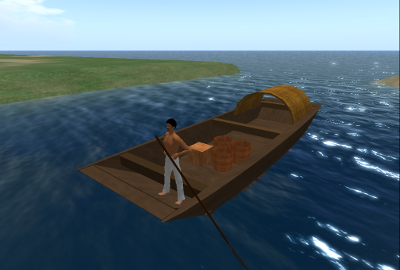
Prim casco (19th century river boat)

This flat bottomed boat was quite common in 19th century Pasig river in Manila. It was used to transport goods across the river and along the canals that led to warehouses.


Too bad I couldn't get boat scripts to work properly. When I drop the script on the boat itself it would not move. It probably have something to do with parts of the boat exceeding 10m. When I use a test cube it functions, but when I stand up the cube sinks to the bottom. There must be something wrong with my setting of physics or the lsl script. I would need more study on boats in OpenSim to get this to work.

Downloads

http://www.mediafire.com/file/x88pmzr2iru6a00/casco_ccbysaph.iar (408.47 kb)

http://www.mediafire.com/file/ssbnjku478l4go0/casco_xml.zip (408.79 kb)


Copyright Roel Cantada 2010
 
Creative Commons License
This work is licensed under a Creative Commons Attribution-Share Alike 3.0 Unported License.